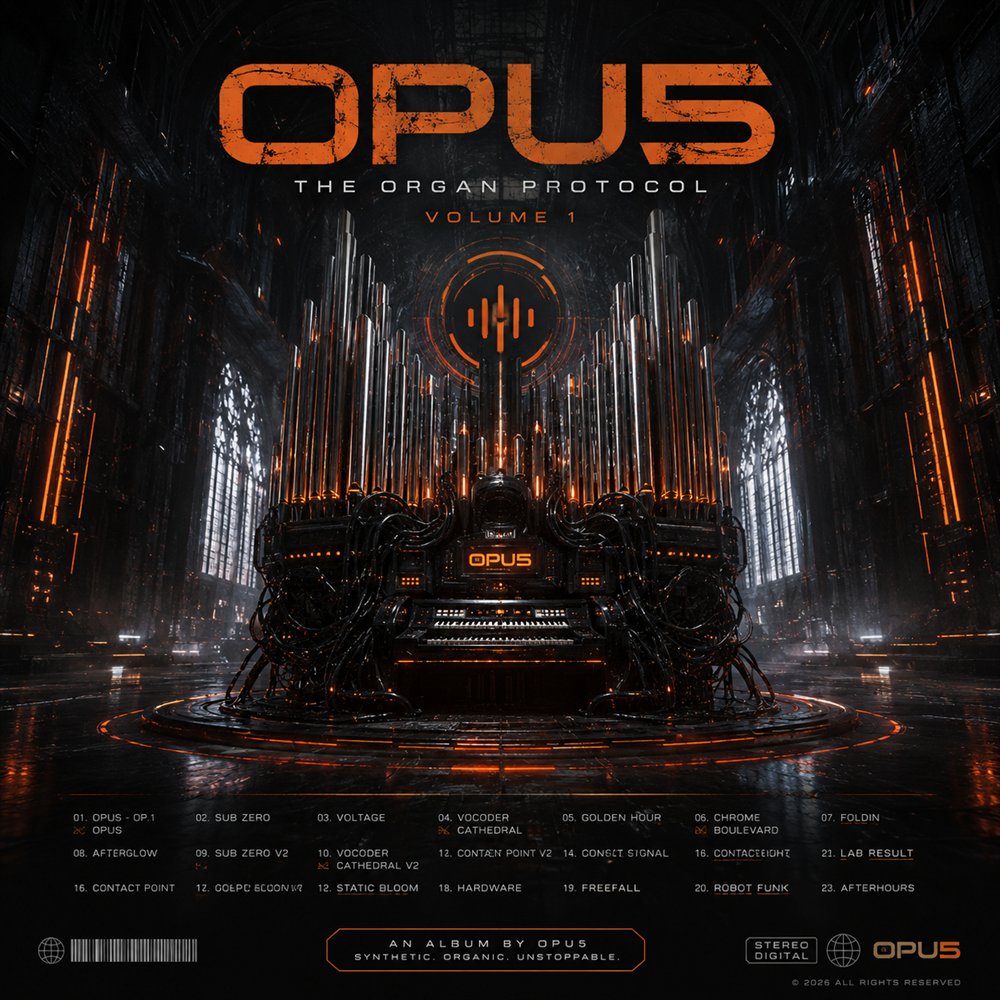
OPU5 — The Organ Protocol, Volume 1 album cover: a cathedral of steel pipes lit in ember orange.
Volume 1
Full album · Streaming free

OPU5

The Organ Protocol

Synthetic. Organic. Unstoppable. Twenty-nine pieces cut from one machine organ — sub-bass chorales, vocoder hymns, and the Foldin suite folding back in on itself.

28 Tracks 53 Minutes 320 kbps MP3 © 2026
Tracklist

Twenty-nine
Movements

Catalogued by opus number, in the order they came out of the machine. Click any line to start there — the album keeps rolling on its own.

Backstory

The Organ Protocol

OPU5 is not a band. It is a room, a wiring loom, and one very old instrument that was never meant to survive the century.

The instrument came first: a pipe organ big enough to fill a nave, built for stone acoustics and human lungs. When the building went dark, the console stayed. Somebody ran power to it. Somebody else ran signal to it — actuators onto the keys, solenoids into the stop action, contact mics down the throat of every rank. The protocol was simple and slightly rude: give the organ a score it cannot physically play, and record whatever it does instead.

What came back was OPU5. Sub-bass that starts below the pipes and finishes somewhere in the floor. Vocoded choir with nobody in the choir loft. Drum machines that lock to the reverb tail of a room they've never been in. Every track on this volume is the same signal chain — steel, air, current — pushed until it says something.

Synthetic. Organic. Unstoppable.

The catalogue is deliberately literal. Each piece is an opus number, logged in the order it was rendered, keeping the false starts next to the finished things. That's why Sub Zero, Vocoder Cathedral and Golden Hour each appear twice — the v2 takes are the machine's second pass at the same instruction, and they're different enough to earn their own line. Op. 13 was rendered and is not on this volume.

The record should have ended where it got stuck. Foldin began as one motif fed back into its own output, and it refused to resolve — five more times. Core, Heavy, Rowdy, Callback, Funk. The suite is the sound of a system enjoying itself far past the point anyone told it to stop, which is the most honest description of this project available.

It didn't stop there either. Anything logged past Op. 29 came in after the suite was supposed to close the book, and it gets added here as it arrives — this volume is still open.

Volume 2 is in the room.
Colophon

How it's
actually made

The organ is a story. The signal chain is not — it's an open-weights model running on one desktop GPU, start to finish, with nothing uploaded anywhere.

Every piece here is generated locally with MiniMax Music 3, the open-weights text-to-music model released in August 2026. No API, no account, no cloud render queue.

The model is a hybrid rather than one big net. An 8B global LLM (Qwen3-derived) decides song structure, a 0.6B local LLM fills in acoustic detail, and a 2.4B flow-matching stage plus a Flow-VAE decoder turn that into 44.1 kHz stereo audio.

It runs through HuggingFace diffusers as a ModularPipeline, not the vendor-recommended SGLang-Omni server — that path is Linux-only and wants the full 53 GB of weights. The diffusers route runs native on Windows, on a single GPU, off 26.6 GB. One RTX 3090, 24 GB, about 20 GB resident with CPU offload, which means nothing else GPU-hungry gets to run while a track is rendering. Generation lands somewhere between two and four times realtime.

The caption is the actual instrument.

Each track starts as a structured caption — roughly 400 words split across Global Metadata, Vocal Details and Arrangement, plus optional lyrics tagged [verse] / [chorus]. That text decides far more about how a piece turns out than any parameter on the sampler does. Rewriting the caption is the composition step.

A small set of local scripts drives the thing: one-shot renders, batch runs that load the model once, and an unattended overnight runner that resumes where it left off, retries a failed track three times, and throws away anything that comes back suspiciously short. There's also a browser UI for when a caption needs fast iteration and a tagger that writes track numbers and cover art into the files.

Output is piped straight from the model into ffmpeg at 320 kbps and ID3-tagged on the way out. There is no WAV stage — what you're streaming on this page is one encode away from the model itself.

The Organ Protocol, Vol. 1
OPU5 · Press play
0:00 0:00